How does it work?
The concept is based on GPS-positioning, which is rarely utilized in railway applications. It is no secret that GPS often can be inaccurate, rendering it too unstable for positioning of trains. How useful would the signalling system be if a train was jumping between two tracks every other meter? Completely useless. Therefore, GPS needs some help:
AI-based camera detection of tracks
The concept is simple: By using locomotive-mounted cameras that continuously record the tracks in front of the train, it can decide on its own what track it is occupying! The point is to complement the GPS-position. A suitable computer-vision model can be used for numerous applications:
Track recognition
Track recongnition can be used by the on-board computer to see the number of tracks and identify which one the train is occupying. See the following proof-of-concept video:
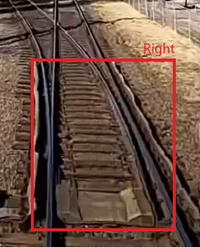
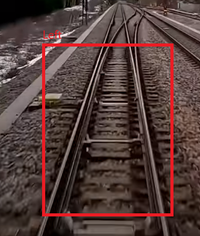
Switch recognition
Railroad switches have a distinct look depending on their direction. By training a computer-vision model to recognize the switches' directions, the train will always know where it is about to drive! It can be seen as a node-link system. As long as the train knew what track it started on, it will always know its position based on the switches' directions! This can be used as a strategy for positioning as well as moving-block technology.
Signal and sign recognition
By training a computer vision model to recognize signals and signs, particulary stop marker boards in ERTMS, driverless trains can be facilitated The train needs to know how long it can drive and where to stop. Furthermore, the train needs to know where it has to stop at a platform based on its length.
For shunting trains, sign recognition is vital for movements on the yard. Previously, switch recognition was described. On shunting yards however, switches can be equipped with complementary directional signals, which show what direction the switch is in. This can be used for driverless shunting trains that move autonomously around the yard.
Rail vehicle recognition
Autonomous trains need to know where other trains and cars are located. Particulary shunting trains need to see when it is approaching another car or train.